Comments related to the need for improved vertical resolution:
Comments related to the need for improved temporal resolution:
Comments related to the need for improved horizontal resolution:
2. Characteristics of VCP 11 and VCP 21
 |
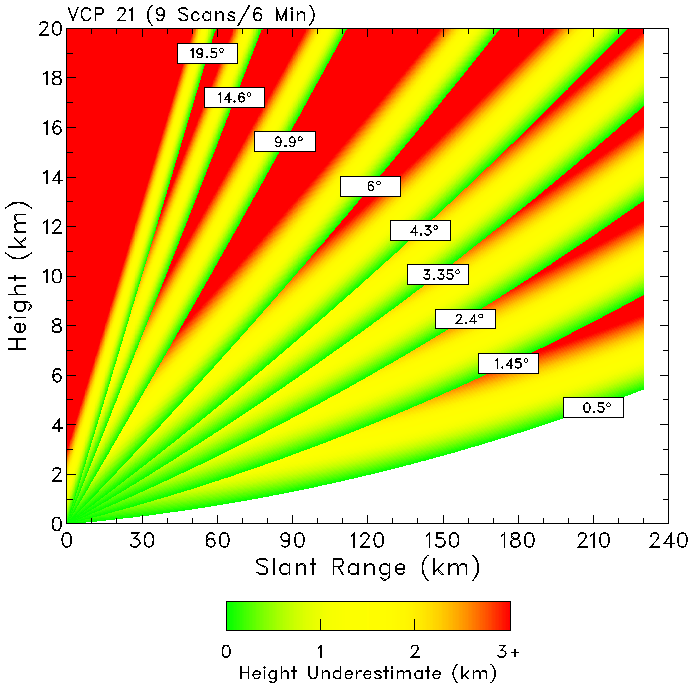 |
| Fig. 1. Height of VCP 11's elevation angles as a function of slant range. The center of the radar beam lies along the labeled line (boundary between red and green). The height of a storm feature that lies between two elevation is determined by the lower elevation angle and therefore is underestimated by the amount indicated by the colored bands. | Fig. 2. Same as Fig. 1, except for VCP 21. |
 |
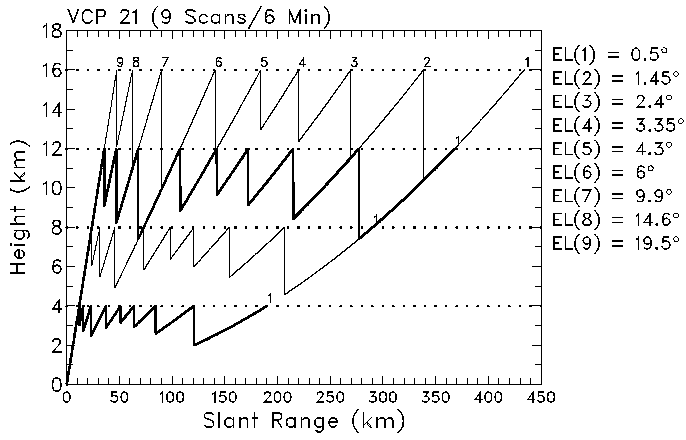 |
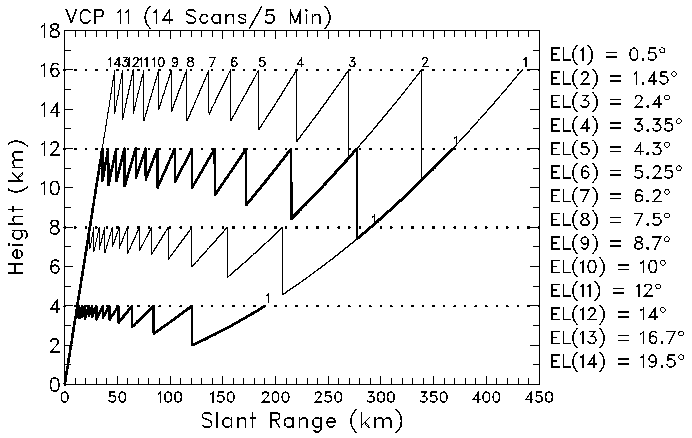
| Fig. 3. Variation of the apparent height of a storm feature as a function of range for VCP 11. The dotted horizontal line shows the true height of a feature and the jagged line shows the apparent height measured by the radar. The elevation tilts are labeled 1-14 and are identified on the right side of the figure. | Fig. 4. Same as Fig. 3, except for VCP 21. |
 |
 |
|
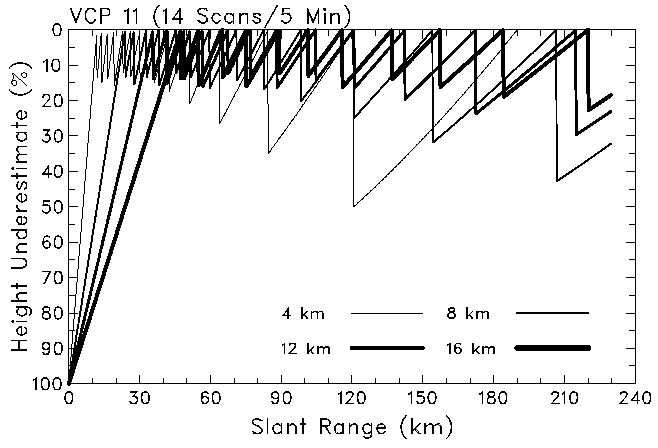
Fig. 5. Replotting of the jagged curves from Fig. 3 as normalized curves (VCP 11). The height of each jagged curve is expressed as a percent height uncertainty relative to the true height indicated by the respective dotted line in Fig. 3. |
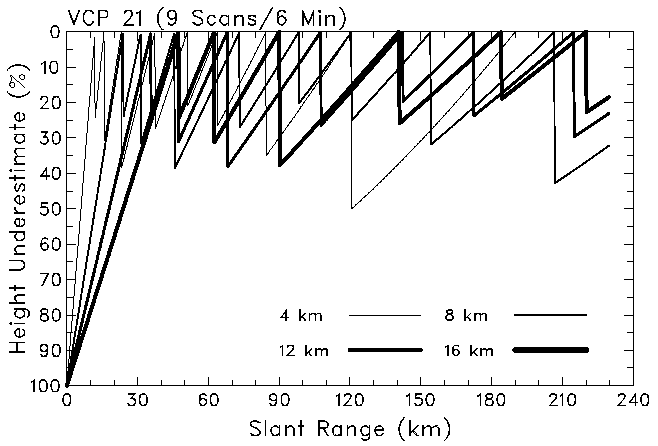
Fig. 6. Same as Fig. 5, except for VCP 21. |
3. Technique for optimizing VCPs
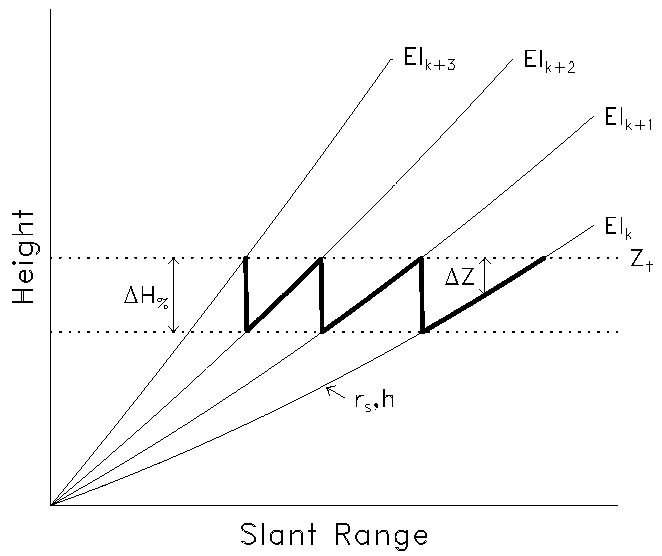
 H%) as a percentage of Zt. Finally, one specifies the minimum elevation angle (Elk) and maximum elevation angle. Though a lower minimum elevation angle is desirable (see section 6), we chose the current value of 0.5o for the minimum angle. Since the WSR-88D was designed with a mechanical stop at 60o elevation, we specified the maximum elevation angle to be 58o. One needs the higher elevation angles to document storm evolution over populated areas close to the radar.
 |
|
Fig. 7. Schematic of the process used to compute optimized VCPs. See discussion in the text for details. |
Z = Zt - h). When Z equals H% , one jumps back up to Zt and computes the elevation angle (Elk+1) that corresponds to that slant range and Zt. Then one repeats the process until the new Z equals H%. In this way, one develops a VCP that has a consistent maximum height underestimate.
 |
 |
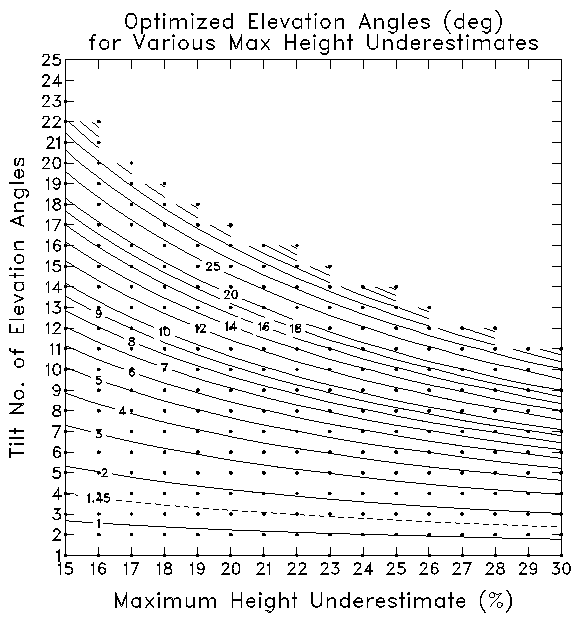
| Fig. 8. Plots of volume scan times from Table 1 as a function of the number of elevation tilts for a number of flexible VCPs represented by various maximum height underestimates. | Fig. 9. Plots of elevation angles from Table 1 as a function of the number of elevation tilts for a number of flexible VCPs represented by various maximum height underestimates. |
 |
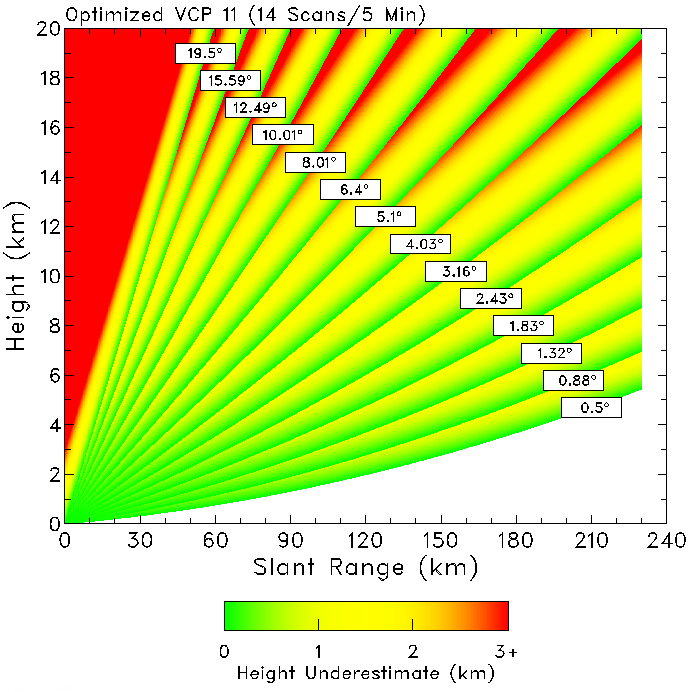 |
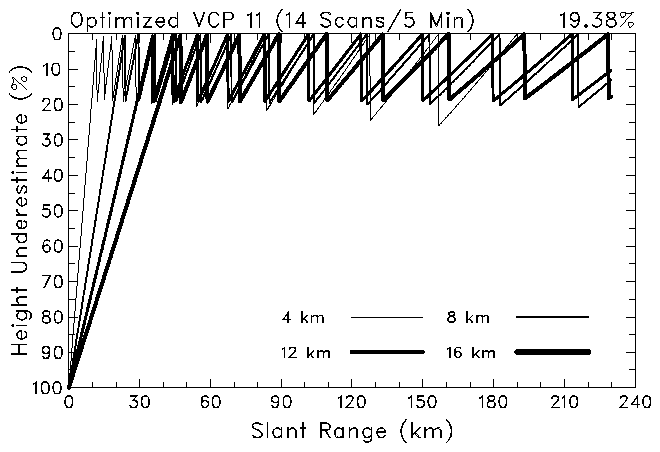
| Fig. 10. Same as Fig. 5, except for optimized VCP 11. | Fig. 11. Same as Fig. 1, except for optimized VCP 11. |
4. VCPs having improved vertical and temporal resolution
a. Strategies for new VCPs
b. Development of VCP A
 |
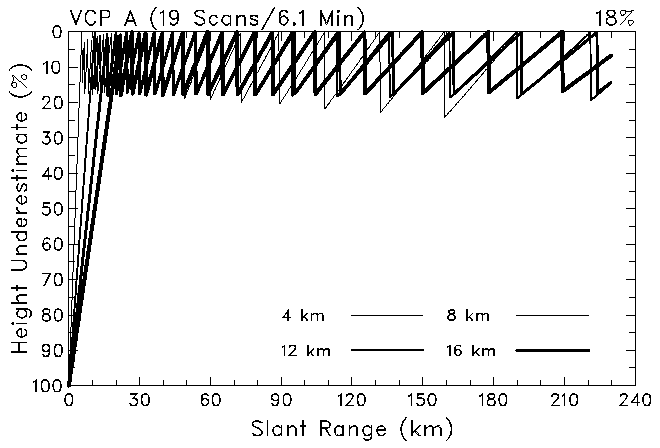 |
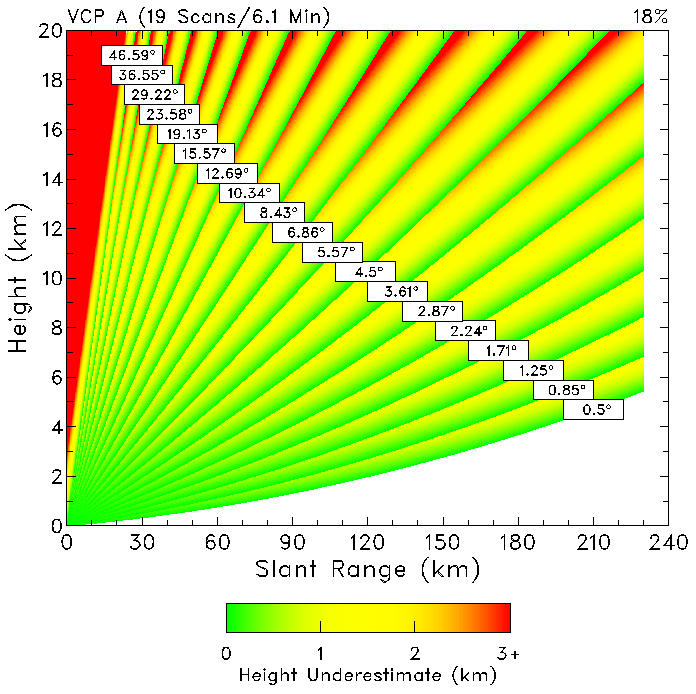
| Fig. 12. Same as Fig. 1, except for optimized VCP A. | Fig. 13. Same as Fig. 5, except for VCP A. |
c. Development of VCP B
 |
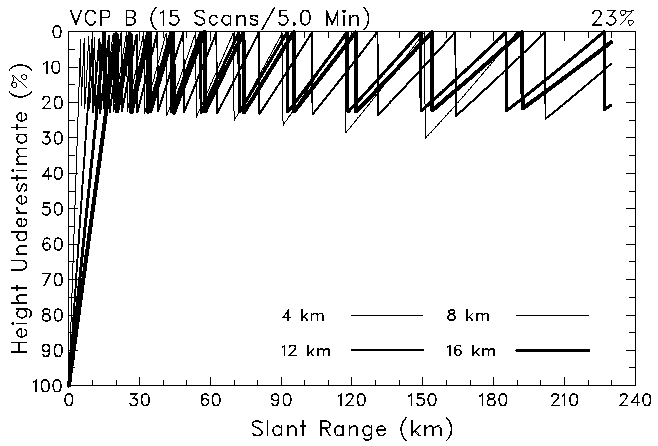 |
| Fig. 14. Same as Fig. 1, except for optimized VCP B. | Fig. 15. Same as Fig. 5, except for VCP B. |
d. Testing improved vertical resolution
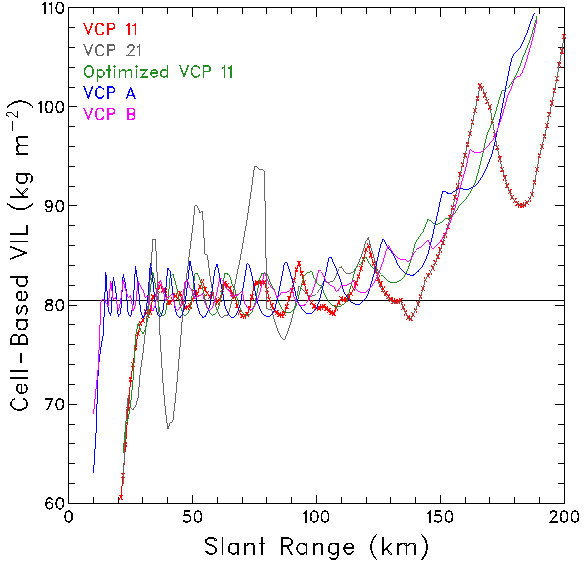
z values of 0.1 km, is 80.5 kg m-2.
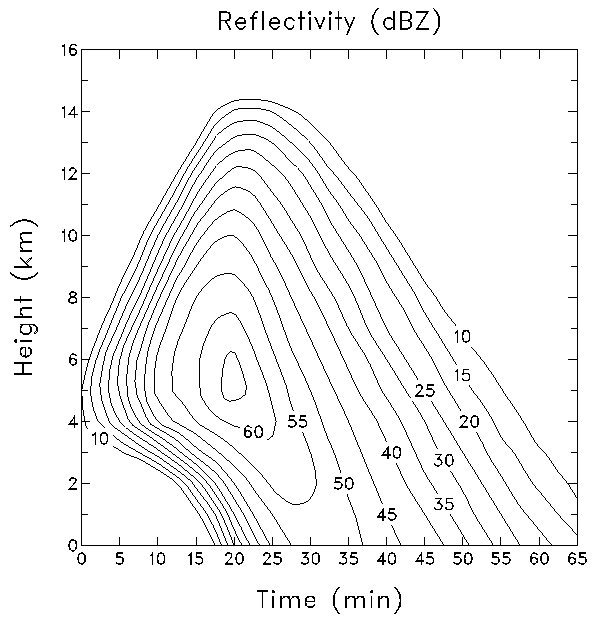 Fig. 16. Schematic time-height plot of maximum reflectivity within a cell of a multicell storm. The schematic is based on a composite of data from an Alabama hail- and microburst-producing multicell storm (Kingsmill and Wakimoto 1991) and a North Dakota hail-producing multicell storm (Torgerson and Brown 1996).
|
z) extending from halfway to the adjacent lower elevation angle to halfway to the adjacent higher elevation angle. So, as z increases with range, the height interval containing the largest reflectivity values carries an increasing amount of weight in computing the VIL value. Beyond about 125 km, the VCP 11 (red x) and VCP 21 (gray line) curves coincide because most of storm depth is below 5.25o, where elevation angles are the same.
 |
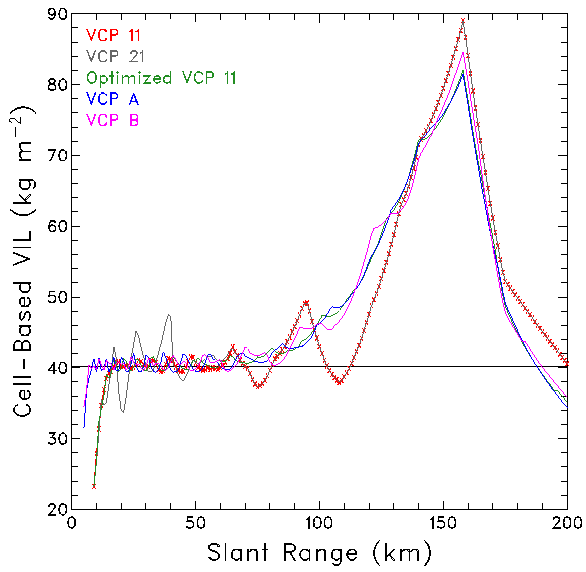 |
Fig. 17. Vertically integrated liquid computed as a function of range from the reflectivity composite in Fig. 16. The vertical reflectivity profile at 20 min was used for the computations. The horizontal line is the true VIL value of 80.5 kg m-2. VCP 11 is indicated by red Xs. |
Fig. 18. Vertically integrated liquid computed as a function of range from a reflectivity composite. The composite had half the height scale and half the time scale of the one in Fig. 16. The vertical reflectivity profile at 10 min (comparable to 20 min in Fig. 16) was used for the computations. The horizontal line is the true VIL value of 40.2 kg m-2. VCP 11 is indicated by red Xs. |
e. Testing improved temporal resolution
 |
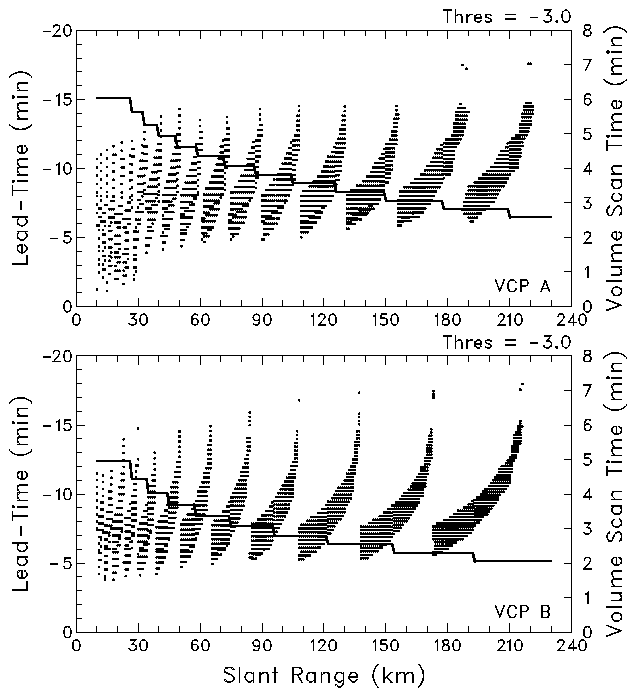 |
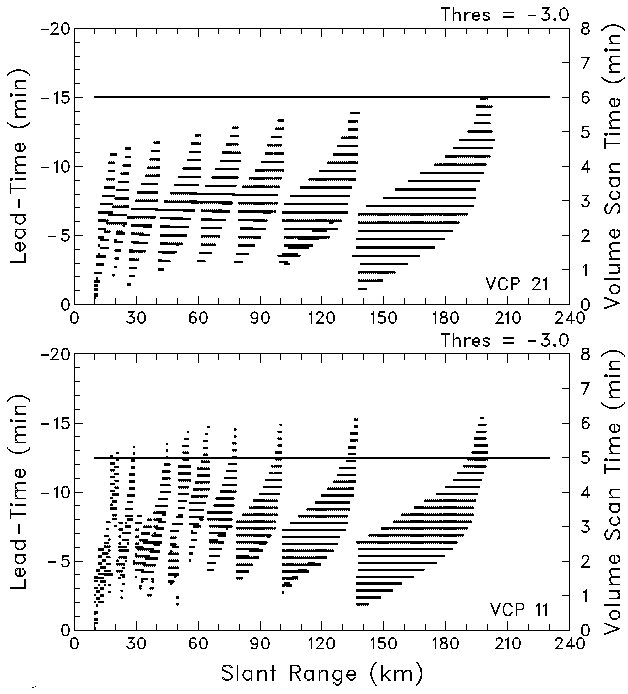
Fig. 19. Downburst lead-times as a function of slant range for the reflectivity composite in Fig. 16 using VCP 21 (top) and VCP 11 (bottom). The 10 dots or horizontal lines at each range represent the 10 lead-times that were computed from a set of volume scans that were offset from each other by one-tenth the time interval between volume scans. The set of 10 offset scans is a proxy for all of the possible random placements of volume scans relative to the reflectivity core region. The thick line indicates the time it takes to complete one volume scan (scale on the right). |
Fig. 20. Same as Fig. 19, except for VCP A (top) and VCP B (bottom). |
5. Improving horizontal resolution
a. Improved tornado detection
AZ). The Rankine model of the tornado had peak rotational velocities of 100 m s-1 at a core radius of 250 m. Figure 21 shows comparisons of simulated TVSs at a range of 50 km from the radar for the two azimuthal increments. The pointed curve is the original Rankine vortex. Owing to the radar beam being considerably wider than the vortex, the data points lie along a degraded TVS curve, where the peak values are significantly less than 100 m s-1 (velocity differences between peaks are significantly less than 200 m s-1). With 1.0o azimuthal increments (Fig. 21a), the Doppler velocity difference between the peaks of the TVS curve is 82 m s-1. The placement of data points along the TVS curve varies from one radar scan to the next past the tornado. Here, the velocity difference between the extreme data points (V) is 65.0 m s-1. The Doppler velocity difference varies from scan to scan, depending on where the data points fall relative to the peaks of the TVS curve.
AZ. However, there also is a less obvious improvement with 0.5o AZ. The horizontal beamwidth is effectively broadened when the antenna moves a significant amount while the required number of pulses are being transmitted. Since 0.5o azimuthal sampling uses half the number of pulses compared with 1.0o sampling, the nominal effective beamwidth decreases from 1.29o for 1.0o AZ to 1.02o for 0.5o AZ. With a smaller effective beamwidth, there is less degradation of the vortex. Consequently, the velocity difference between the peaks of the TVS curve increased from 82 m s-1 for 1.0o increments to 95 m s-1 for 0.5o increments.
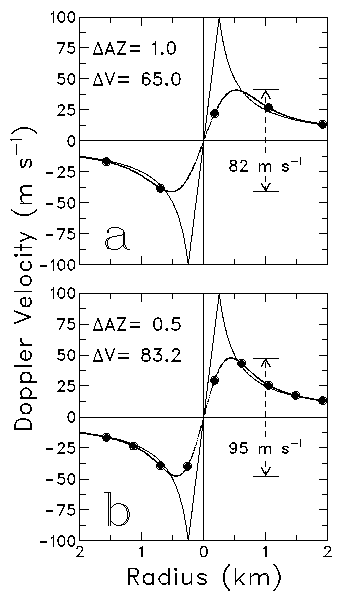 Fig. 21. Example of simulated TVS data points along degraded TVS curves for (a) 1.0o and (b) 0.5o azimuthal sampling (AZ) at a range of 50 km from the radar. The pointed curve represents the tornado being sampled (peak rotational velocity of 100 m s-1 at a core radius of 250 m). The Doppler velocity difference (V) between the extreme positive and negative data points is a measure of the TVS.
|
V measurements that are likely to occur for (a) the various possible locations of the radar beam relative to the tornado and (b) the addition of Gaussian-distributed white noise (mean of zero) to the Doppler velocity computations to simulate the noisiness in Doppler velocity measurements. When one decreases the number of pulses by a factor of 2 to produce 0.5o azimuthal sampling intervals, the noisiness or standard deviation of the Doppler velocity estimates increases by the square root of 2 (that is, by a factor of 1.4). For the conventional 1.0o azimuthal sampling, the standard deviation is about 2.5 m s-1. For the proposed 0.5o azimuthal sampling, the standard deviation increases to 3.5 m s-1.
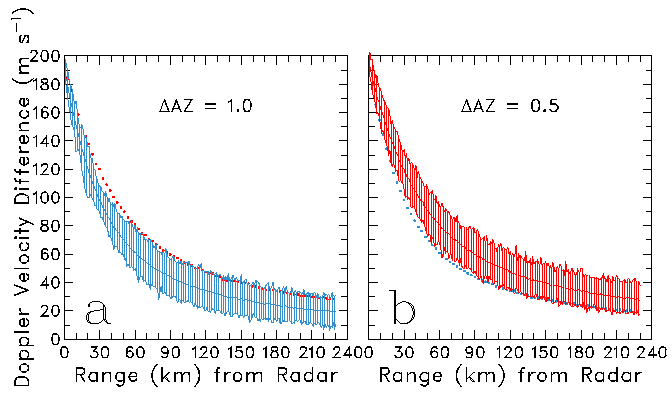
Fig. 22. Distribution of TVS Doppler velocity differences ( |
V at each radar range. The V estimates represent 121 different placements of the vortex center relative to the beam center over one AZ interval. The dotted line represents the location of the solid line in the other half of the figure. It is clear from Fig. 22 that, for the given tornado at a given range, the radar measured a stronger Doppler velocity difference with 0.5o AZ than with 1.0o AZ. On the average, the difference between the two curves is 10-20 m s-1.
V across the two bands at a range of 50 km from the radar. The mean value of V is 21 m s-1 stronger with 0.5o AZ. One sees that most of the possible V values occur near the center of the bands with fewer occurring at the edges. Contrary to what one might infer from the shaded bands in Fig. 22, only a small fraction of the possible V values in the two distributions actually overlaps.
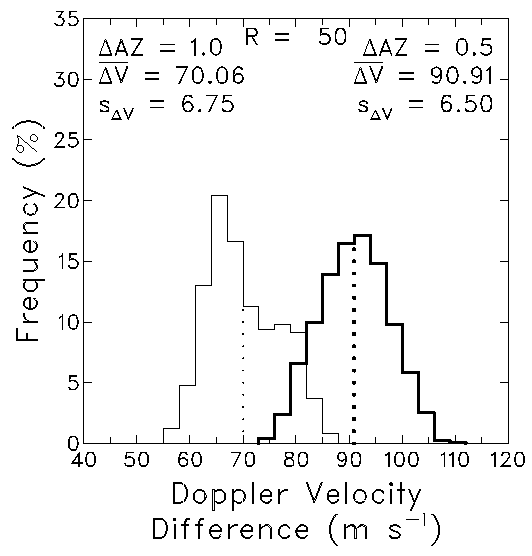
Fig. 23. Frequency distributions of TVS Doppler velocity differences ( |
V value is strong enough to represent a TVS. Using the mean curves in Fig. 22, it is possible to select a V threshold value and determine how much farther in range one can detect values greater than or equal to the threshold value. For example, a threshold velocity difference of 40 m s-1 occurs at a range of 102 km for 1.0o AZ, while it occurs at a range of 150 km for 0.5o AZ; 150 km is 1.47 times farther in range than 102 km. Plotted in Fig. 24 are the ratios of maximum range at which a particular V value can be detected using 0.5o AZ relative to the maximum range using 1.0o AZ. The ratios occur in a narrow band from 1.45 to 1.55 for all V thresholds. This means that one can detect a particular V threshold at 45-55% greater distances on the average using 0.5o azimuthal sampling. In terms of horizontal coverage, the area exceeding a particular threshold value is doubled on the average using 0.5o azimuthal sampling, which is very significant from an operational perspective.
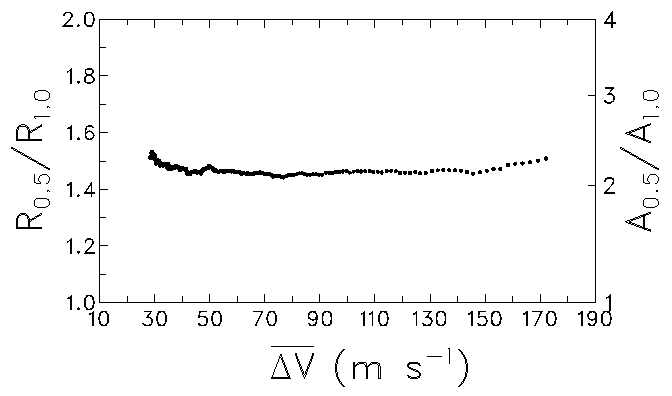
Fig. 24. Ratios of the range (R) using 0.5o azimuthal sampling to the range using 1.0o sampling for mean |
b. Improved mesocyclone detection
AZ do a much better job than 1.0o AZ in representing the peaks of the mesocyclone curve. Also, with a smaller effective beamwidth, the peaks of the mesocyclone curve are closer to the model peaks of 25 m s-1 with 0.5o azimuthal sampling.
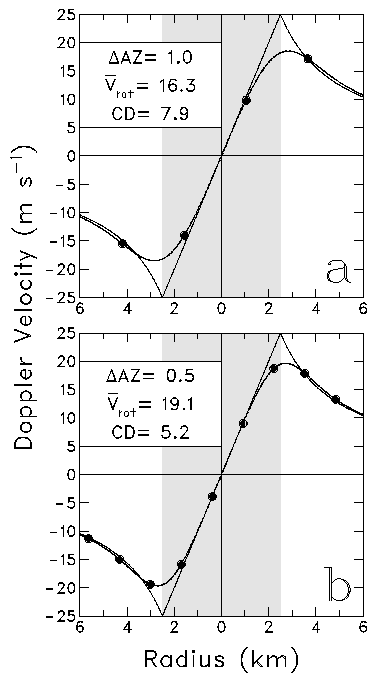
Fig. 25. Example of simulated mesocyclone signature data points along degraded mesocyclone signature curves for (a) 1.0o and (b) 0.5o azimuthal sampling ( |
 |
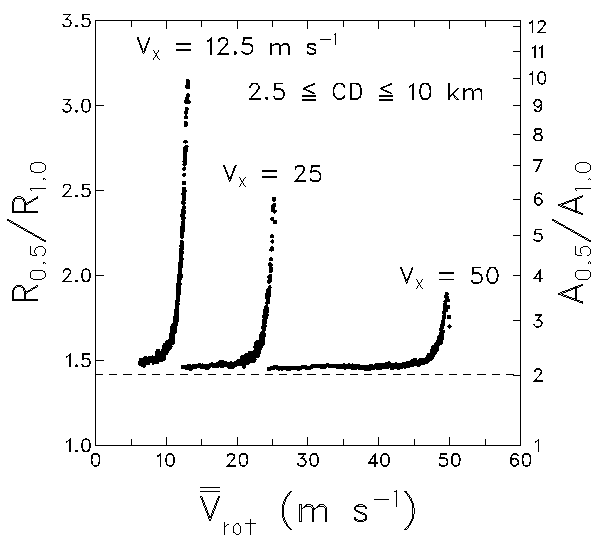 |
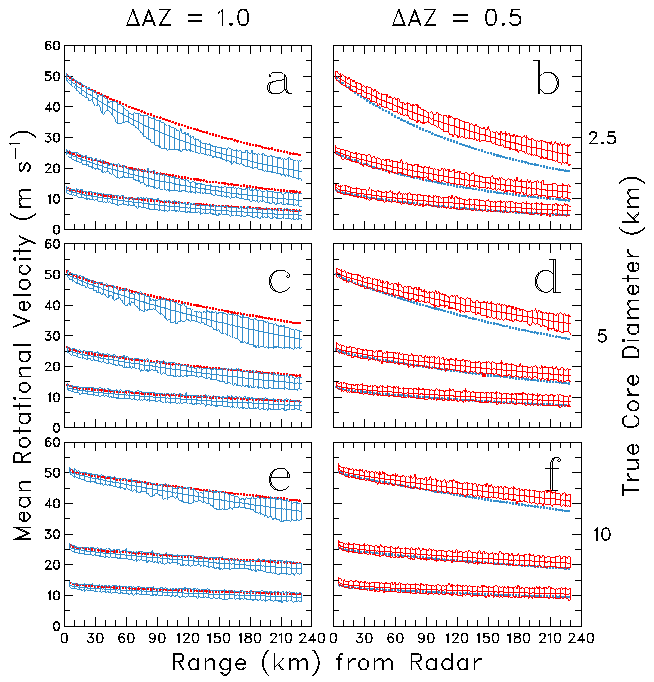
Fig. 26. Same as Fig. 22, except for mean rotational velocities for Doppler velocity signatures of mesocyclones having peak rotational velocities of 12.5, 25 and 50 m s-1 (the three curves in each part of the figure) and core diameters of 2.5 (a, b), 5 (c, d) and 10 km (e, f). |
Fig. 27. Same as Fig. 24, except for mesocyclones having peak rotational velocities (Vx) of 12.5, 25 and 50 m s-1. Each curve is the blending of curves for mesocyclones with core diameters (CD) of 2.5, 5 and 10 km. The abscissa is the average mean rotational velocity that is indicated by the curves down the center of the shaded bands in Fig. 26. |
AZ, compared to 1.0o AZ. The coverage area increases because mesocyclones and tornadoes have stronger Doppler velocity signatures with 0.5o AZ at all ranges from the radar. Therefore, it is advisable for all new convective storm VCPs to use azimuthal increments of 0.5o instead of 1.0o.
6. A look at an initial elevation angle of 0.3o
7. Recommendations
1. Optimized VCPs (Section 3). We developed a technique for computing "optimized" VCPs. The maximum height underestimate (expressed as a percentage) owing to finite increments between elevation angles is essentially the same at all heights and all ranges. Besides providing a logical increase in the separation of elevation angles with increasing elevation angle, the technique assures adequate sampling of distant storms. We recommend that all future VCPs be developed using this optimization technique.
2. Flexible VCPs (Section 4). To improve temporal resolution without sacrificing vertical resolution, the VCPs used by the WSR-88D should be flexible. That is, there should be an algorithm that ends a volume scan after detecting two consecutive elevation angles having no radar return. We recommend that all future VCPs be flexible, so that, when conditions merit, a VCP can be ended before it reaches the maximum elevation angle.
3. Faster VCPs (Section 4). The evolution of some severe weather phenomena (such as tornadoes and downbursts) is so rapid that forecasters are at a disadvantage in issuing warnings based on 5- and 6-minute VCPs. Faster VCPs will improve the warning process. By the time that fast VCPs are implemented, the communication links will have been upgraded so they can handle the increased flow of information. In addition to using flexible VCPs for decreasing volume scan time, we recommend that all future VCPs use maximum antenna rotation rates that are consistent with specified maximum Doppler velocity and reflectivity estimates of error.
4. Improve horizontal resolution (Section 5). Simulations of WSR-88D data collected in model mesocyclones and tornadoes show that the range of mesocyclone and tornadic vortex signature detection increases by 50% when data are collected at 0.5o instead of the conventional 1.0o azimuthal increment. This increase is equivalent to doubling the detection area. We recommend that all VCPs developed for convective storm detection collect data using a 0.5o azimuthal increment.
5. Increase the maximum elevation angle (Sections 3 and 4). The current VCPs 11 and 21 do not tilt higher than 19.5o. The volume of space between 19.5 and 90o is literally a "cone of silence", where the radar cannot detect storm features. The narrow band of data that appears on a PPI display at high elevation angles is difficult for a human to interpret. Also, Doppler velocity measurements at higher elevation angles contain a significant bias from precipitation fall speeds. However, the higher elevation angles provide a wealth of additional reflectivity information to the algorithms that ultimately benefits the users. Therefore, we recommend that all optimized VCPs include elevation angles up to 60o, which is the mechanical upper limit for the antenna.
6. Decrease the lowest elevation angle (Section 6). A theoretical study suggests that the WSR-88D antenna can be lowered to 0.3o without degrading WSR-88D reflectivity and Doppler velocity measurements. Decreasing the lowest elevation angle from 0.5o to 0.3o will increase the range of detection by 15-20 km. Also, at a given range, it will lower the height of the lowest data points by 0.4 km at 115 km range and by 0.8 km at 230 km range. Though these improvements appear to be minimal, they can be significant in dealing with convective phenomena that are only 1-3 km deep. We recommend that the lowest elevation angle be decreased to 0.3o.
7. Make algorithm developers/modifiers aware of upcoming VCP changes. At the present time, new VCPs cannot be added to the WSR-88D system until changes are made to some of the algorithms. Users have been requesting VCP changes for years, but nothing has happened because there is no easy way to modify the algorithms. We are proposing changes that likely will affect all of the WSR-88D algorithms. In preparation for these changes, we recommend that algorithm developers and modifiers be mandated to add flexibility to their algorithms that will easily allow changes to be made to such parameters as elevation angle (from negative angles for mountaintop radars up through 60o), number of elevation angles, horizontal azimuthal increment, rotation rate, VCP recycle time, etc.
8. Replace VCP 11 and VCP 21. VCPs 11 and 21 do not do a very good job in resolving nearby and far-range convective storms. Using the optimization technique developed for this study, we prepared new VCPs A and B that include the types of changes that forecasters have requested to help them with issuing more timely and accurate warnings. We recommend that VCP 11 and VCP 21 be replaced with optimized VCPs, such as those typified by VCP A and VCP B (fast rotation rates, elevation angles from 0.3o to 60o for non-mountaintop radars, horizontal azimuthal increment of 0.5o, ability to end the VCP partway through the sequence).
Brown, R. A., and V. T. Wood, 1998: Technique for improving WSR-88D detection of tornadoes. Preprints, 19th Conf. on Severe Local Storms, Minneapolis, Amer. Meteor. Soc., 721-724.
Brown, R. A., L. R. Lemon and D. W. Burgess, 1978: Tornado detection by pulsed Doppler radar. Mon. Wea. Rev., 106, 29-38.
Greene, D. R., and R. A. Clark, 1972: Vertically integrated liquid: A new analysis tool. Mon. Wea. Rev., 100, 548-552.
Greene, D. R., J. D. Nilsen, R. E. Saffle, D. W. Holmes, M. D. Hudlow and P. R. Ahnert, 1983: RADAP II, An interim radar data processor. Preprints, 21st Conf. on Radar Meteor., Edmonton, Amer. Meteor. Soc., 404-408.
Howard, K. W, J. J. Gorley, and R. A. Maddox, 1997: Uncertainties in WSR-88D measurements and their impacts on monitoring life cycles. Wea. Forecasting, 12, 166-174.
Kingsmill, D. E., and R. M. Wakimoto, 1991: Kinematic, dynamic, and thermodynamic analysis of a weakly sheared severe thunderstorm over northern Alabama. Mon. Wea. Rev., 119, 262-297.
Maddox, R. A., D. S. Zaras, P. L. MacKeen, J. J. Gorley, R. Rabin and K. W. Howard, 1999: Echo height measurements with the WSR-88D: Use of data from single versus two radars. Wea. Forecasting, 14 (in press).
Mahoney, E. A., and R. Schaar, 1993: WSR-88D scan strategy impacts on the vertically integrated liquid product. Preprints, 26th Intern. Conf. on Radar Meteor., Norman, OK, Amer. Meteor. Soc., 44-46.
Roberts, R. D., and J. W. Wilson, 1989: A proposed microburst nowcasting procedure using single-Doppler radar. J. Appl. Meteor., 28, 285-303.
Saffle, R. E., 1976: D/RADEX products and field operation. Preprints, 17th Conf. on Radar Meteor., Seattle, Amer. Meteor. Soc., 555-559.
Smith, P. L., 1998: On the minimum useful elevation angle for weather surveillance radar scans. J. Atmos. Ocean. Technol., 15, 841-843.
Torgerson, K. L., and R. A. Brown, 1996: Radar signatures of updrafts within the Carson, ND hailstorm of 11 July 1989. Preprints, 18th Conf. on Severe Local Storms, San Francisco, Amer. Meteor. Soc., 81-85.
Wood, V. T., and R. A. Brown, 1997: Effects of radar sampling on single-Doppler velocity signatures of mesocyclones and tornadoes. Wea. Forecasting, 12, 928-938.
Wood, V. T., and R. A. Brown, 1998: Improved detection capability of single-Doppler velocity signatures of far-range mesocyclones. Preprints, 19th Conf. on Severe Local Storms, Minneapolis, Amer. Meteor. Soc., 717-720.