David J. Stensrud

David J. Stensrud
Research Meteorologist
Chief Scientist, NOAA Warn-on-Forecast Program
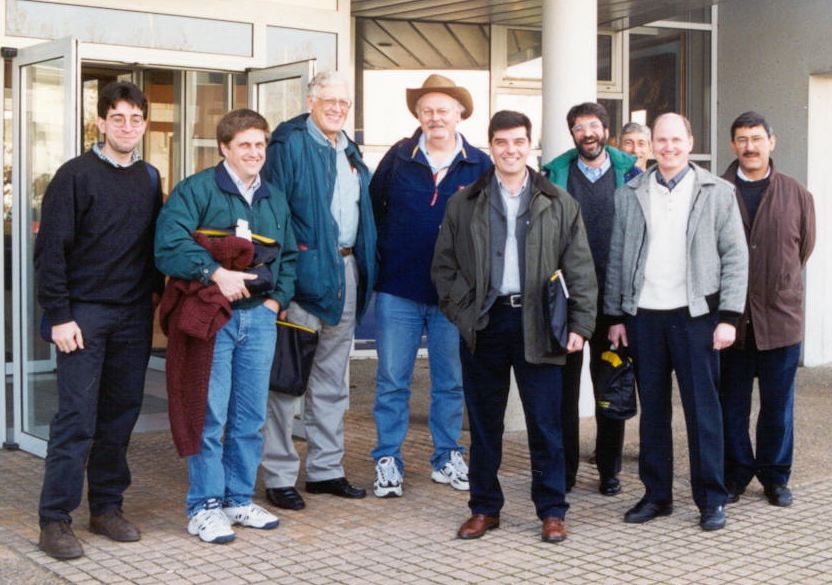
Some of the American, Spanish, and French participants at the
European Conference on
Tornadoes and Severe Storms, held at
Meteo-France in the beautiful city of
Toulouse during February 2000.
From left: Victor Homar Santaner, Harold Brooks, Richard Peterson,
Chuck Doswell, Fermin Elizaga Rodriguez, Miguel Gaya, Jean Dessens,
Dave Stensrud, and Clemente Ramis.
Photograph courtesy of Miguel Gaya of the Instituto Nacional de Meteorologia,
Centre Meteorologique des Iles Baleares, Palma de Mallorca, Spain.
David Stensrud
National Severe Storms Laboratory
Forecast Research and Development Division, Room 2236
National Weather Center
120 David L. Boren Boulevard
Norman, OK 73072

Internet:  David.Stensrud@noaa.gov
Telephone: (405) 325-6170
FAX:       (405) 325-2316
Current Research
My primary research interests are in
- the modeling and forecasting of hazardous weather
- the incorporation of mesoscale features into model intial conditions
- methods to interrogate intelligently mesoscale model output in an operational forecasting environment
- the use of numerical models in the future of weather forecasting with an
emphasis on short-range ensemble forecasting (SREF)
- examining the model partitioning of surface sensible and latent heat
fluxes and their improvement through the incorporation of
satellite-derived land use and land cover data
- the influence of persistent mesoscale regions of convection on the large-scale environment
- ensemble Kalman filter data assimilation as applied to multi-model ensembles
- ensemble post-processing methods
- development of the warn-on-forecast paradigm to extend severe weather warning lead times
- new methods to observe boundary layer depth and assimilating these observations into numerical weather prediction models
More information on my research interests is found in my
Vita.
Educational activities
I'm involved in educational outreach through
- teaching a graduate level class entitled "Parameterization Schemes for Numerical Weather Prediction" at
the University of Oklahoma (once every 4 semesters)
- supervising undergraduates students who are NOAA Hollings Scholars or part of the
Research Experience for Undergraduates (REU) program
- supervising graduate students at the University of Oklahoma as an Affiliate Professor of Meteorology
Return to the NSSL Homepage
Return to the FRDD Homepage